Humans are a persistent bunch when it comes to seeking out alien life.
We've poked under the rocks of distant planets and kept radio telescopes tuned in for "the" signal. So far, however, our efforts have left us empty-handed.
But that's not to say we haven't come close to confirming extraterrestrial existence -- sort of. As the science matures, the evidence seems to become tougher to dismiss.
From the outlandish cities on the moon to mysterious Martian methane plumes, here we cover the top 10 false alarms in the quest for life off Earth.
10. Carnivals on Venus
Armed with the best telescopes of their time, 18th- and 19th-century astronomers began to study Venus obsessively. From their view, the cloud-covered planet looked as if it were covered in mountains and thick jungle, among other fanciful conclusions.
To explain strange bright spots on the dark limb of the planet (caused by the clouds refracting sunlight) German astronomer Franz von Paula Gruithuisen made an interesting conclusion: Venus had inhabitants who "organize festivals and general illuminations" during religious celebrations or changes in government.
Some ridiculed him, but other serious astronomers bought the claims up through the early 1900s.
9. City on the Moon

Gruithuisen didn't stop with contemplating the existence of his extravagant Venetians.
Following in the footsteps of fellow astronomer Johann Schröter, Gruithuisen aimed his telescope at the moon and saw a city built by a civilization of "Lunarians" in 1822. What are in fact craters and natural ridges appeared to be buildings connected by streets leading to a star-shaped temple.
Satirizing such claims, New York Sun writer Richard Locke created the Great Moon Hoax of 1835. Locke tantalized a gullible public with a six-part series falsely quoting astronomer John Herschel about the existence of unicorned goats, rolling amphibious balls, and winged humanoid bats.
8. Canals on Mars

After being duped into believing strange creatures lived on the moon, 19th-century astronomers sought signs of life elsewhere in the solar system.
Astronomer Giovanni Schiaparelli might have drawn up the most detailed yet maps of Mars in 1877 -- used even to select Viking spacecraft landing sites -- but Hubble's best images of the Red Planet leave one to wonder what he actually saw. His most famous contribution was noting a series of "canali," or canals, across Mars.
Talk about the power of suggestion. Bostonian astronomer Percival Lowell ran with Schiaparelli's canali, suggesting that they were "the work of some sort of intelligent beings." To his death Lowell believed in a planet-wide system of irrigation canals, but modern astronomy has since soundly debunked them.
7. The Face on Mars

When NASA's Viking 1 orbiter photographed the Cydonia Mensae region of Mars -- where the Viking 2 orbiter was to touch down -- the world went crazy in July 1976.
In a press release, NASA's Jet Propulsion Laboratory described the famed Face on Mars as an illusion of shadows. Nonetheless, a pareidoliac public was convinced it was the work of an intelligent civilization.
Nearly 25 years later, new images came back from the Mars Global Surveyor showing the face was, without a doubt, just a butte or mesa. With people still unconvinced, however, NASA also released 3-D reconstructions of the feature to firmly quash the claims.
6. Martian Caves

The exterior of Mars is a dry, bone-chilling and altogether unwelcoming place to be. But could life teem in a place shielded from such conditions?
In 2007, scientists announced the discovery of seven holes the size of football fields dubbed the "seven sisters": Annie, Abbey, Chloe, Dena, Nikki, Jeanne and Wendy. The shadowed "cave skylights" are warmer than the surface above, possibly giving life shelter from a harsh Martian landscape.
Until a spacecraft -- or human explorers -- can climb into the mysterious holes to explore for life there, we'll never be certain.
5. Roswell UFOs?

Why bother looking for extraterrestrial life? All you have to do is look up in the sky.
Or better yet, get access to the secret government site in Roswell, N.M., where the remains of an alien spacecraft -- and possibly its occupants -- have been sealed away.
So says Apollo astronaut Edgar Mitchell, who is not alone in his theory that Earth is a popular stopping point for visitors from beyond.
4. Europa's Oceans

Beneath the frozen face of Europa, one of the many moons of Jupiter, lies a liquid ocean warmed by the not-so-gentle gravitational tugs from sibling satellites.
On Earth, water and life seem to be an inseparable pair. While scientists have no reason to think the same isn't true elsewhere in the universe, the proposal is dead in the water until these distant oceans are sounded.
3. Allan Hills Meteorite

For a while, extraterrestrial life had a name: ALH84001.
This meteorite from Mars, which scientists recovered from Antarctica, showed what were initially believed to be fossilized remains of bacteria.
It turned out to be one false step for life beyond Earth, but one giant leap for revitalizing NASA's long-dormant Mars exploration program.
2. SETI's "Wow!" Signal

Microbial life just doesn't cut it for some scientists; it's news of the intelligent variety they crave, particularly those species sociable enough to give us a cosmic "howdy, partner."
Astronomers involved in the Search for Extraterrestrial Intelligence, nicknamed SETI, have spent more than three decades tirelessly combing radio waves for non-naturally occurring signals.
They may have gotten one once -- a signal so "out-there" that an astronomer simply wrote the word "Wow!" on a computer printout of the blip -- but it vanished from the proverbial radar and has never been heard again.
1. Martian Methane

In January 2009, some media outlets reported that NASA had found signs of life on Mars. Thing is, they hadn't ... not yet, anyway.
The news stories surrounded an embargoed report in Science magazine about the discovery of methane plumes on the Red Planet. The early reports were so outlandish, however, that Science didn't even consider its protective embargo on the report broken.
Still, the sources of the atmospheric gas are an intriguing mystery -- not only because on Earth most methane comes from "biological processes" (i.e. cow farts), but because methane is a rich food stock for microbial populations.
Source : http://dsc.discovery.com/space/top-10/alien-life-evidence/index.html


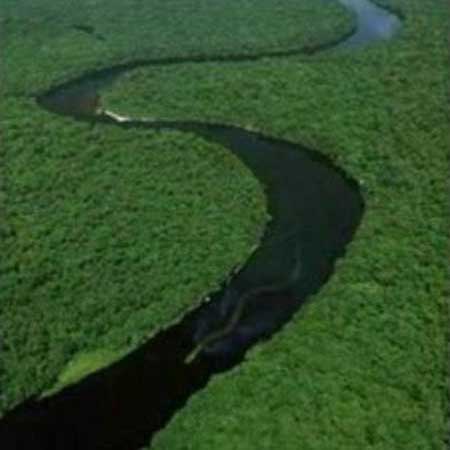 Two photographs have been recently released from unknown sources in Borneo, depicting the weirdest of occurrences – a 100 foot-long snake-like creature cruising in the waters of the Baleh river. Natives are understandably scared of that, as they believe that the alleged monster is the mythical Nabau creature, a dragon-like serpent that has the ability to change its shape whenever it pleases. Western observers are, however, reluctant to accept the pictures as genuine, saying that there are serious clues in them that give away the fact that they are most likely fake.
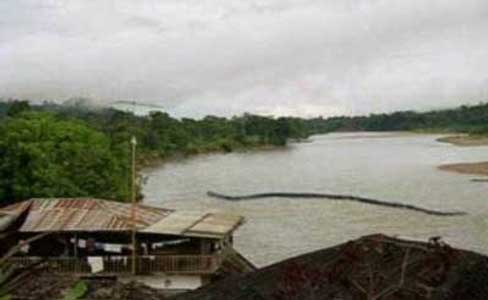 In the second picture, it clearly appears in all its splendor, photographed from the side. Again, notice the fact that the ratio between its size and that of the trees seems to change drastically between the two snapshots. In the first one, it looked like it was thicker than a few trees bound together. In the second, it only appears to be an over-sized snake. Also, its length seems to be smaller. Again, its position is just wonderful for the shot, which allegedly has been taken in a “remote” village.


 Posts
Posts


